Tourism License: 1793/072
-
 Trekking in Nepal
Hire a Certified Trekking Guide in Nepal
Hire a Certified Trekking Guide in Nepal
Are you an independent trekker looking for a local professional trekking guide for a safe and wonderful Nepal trekking experience? If yes, then we are here: a group of licensed guides with decades of experience and expertise, full of passion and dedication in guiding and leading groups in various parts and routes of the Himalayas, from the Kanchenjunga Trek to eastern Nepal and the Dolpo–Api Saipal route to far western Nepal, which is the 1700 km-long Great Himalaya Trail.
Why is it better to hire a guide when going for Nepal trekking?
For a safe and secure mountain holiday, engaging an excellent and experienced trekking guide—or at least a porter-guide—is highly recommended. While major trails to destinations like Everest Base Camp, Annapurna Base Camp, and Langtang Valley are generally well-trodden, the mountains remain unpredictable. Every year, solo trekkers go missing, a sobering reality reflected in the posters of the lost that appear in Kathmandu and along trekking routes.
So it is always wise and advisable to employ a certified guide, or at least a porter-cum-guide (a combination of guide and porter), which is important for safer trekking in Nepal. For a reasonable daily investment, you enhance your safety and ensure a more comfortable, informed, and enriching holiday. We maintain a network of trusted, on-call guides, porter-guides, and porters in Kathmandu for the Everest region and Pokhara for the Annapurna area—all ready to help you trek with greater peace of mind.
What is a typical local Nepal trekking guide like?
Your guide can be from various ethnic groups (Tamang, Sherpa, Gurung, Magar, Rai, etc.) and is an expert on popular guide trails like Annapurna, Langtang, and others. They are incredibly knowledgeable about their specific regions.
The main task and responsibility of the guide:
Most trekkers may think that a guide's task is just navigating a trail, but a guide is a bank of local insight, an arranger, a helper and medium to the local people, and also a first fellow that you meet. And a guide is a friend that can help and assist you in case of critical situations and hazards in a mountain terrain. Your guide will run down at midnight to get you help in an emergency and organize a quick rescue in the high mountains.
In addition, a guide shows you the places of interest, describes the traditions, cultures, and religion; shows shortcut trails; and asks the locals about route conditions, making your holiday more beautifully memorable. We and our guides are highly experienced and well-trained by the Government of Nepal, Ministry of Civil Aviation and Tourism, and dedicated to our job. We suggest that hiring a guide or at least a porter-cum-guide is necessary for trekking in a remote part of Nepal.
Porter cum Guide
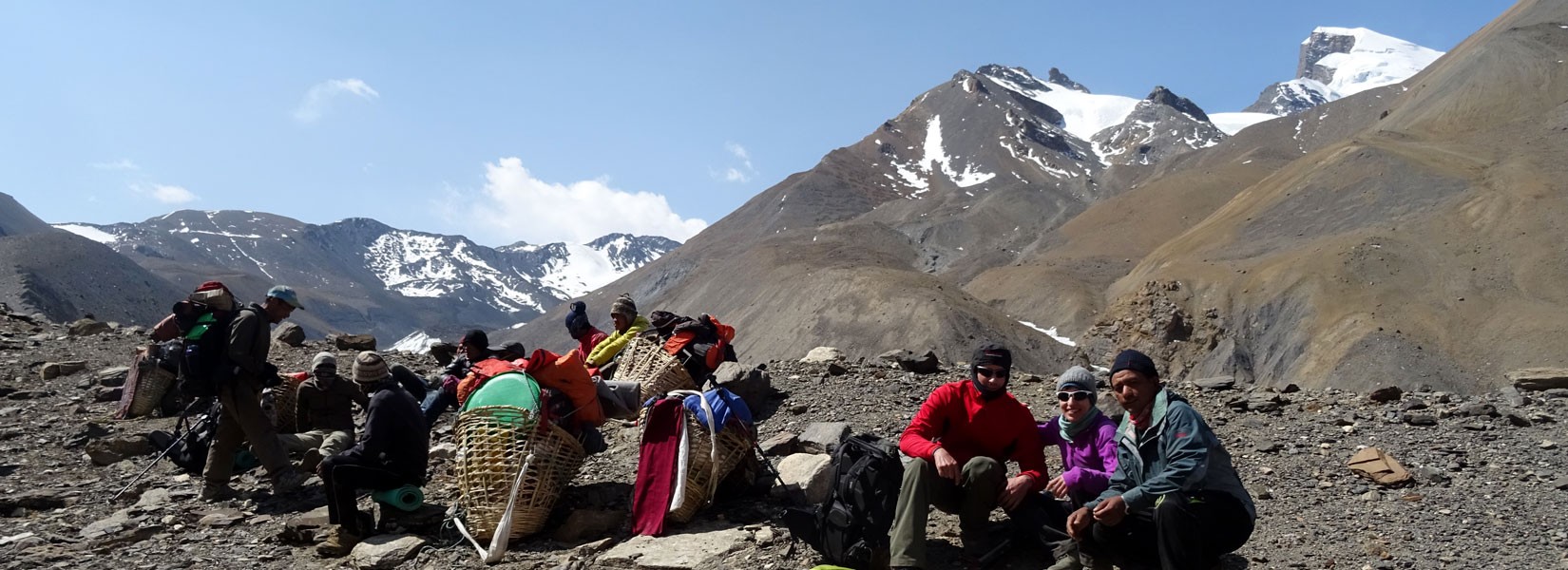
A porter guide carries your gear, guides you on the trail, and speaks basic English, good enough to communicate and understand your needs. They are pleasant, kind, and sincere, as well as trustworthy on their job, and stay together with you during your trekking. Most guides, or porter-cum-guides, are from remote villages and various parts of the mountain region of Nepal so that they are strong with well-formed bodies and naturally adapted to the altitude, which makes them less likely to get altitude sickness. So you would say “altitude sickness-resistant people”?
Trekking Porter
A kind of strong person from an isolated mountain village who carries your gear and doesn’t speak English, but they are pleasant, kind, and sincere as well. They may have to stay separate from you during the trek because, in the Everest region, most of the lodge owners do not accommodate porters, so they stay in porter shelters where food costs are affordable and porter rooms are cozy. Most of the porters are from remote villages of Nepal in search of occasional work in peak trekking season (Sept to Nov and March to May).
Are guides certified and trained by the government?
Nepal trekking guides are trained by government-authorized bodies like the Nepal Academy of Tourism and Hotel Management (NATHM), the Nepal Mountaineering Association (NMA), and the Trekking Agencies Association of Nepal (TAAN), offering courses in first aid, altitude sickness, culture, and guiding skills, leading to licensed certification from the Nepal Tourism Board (NTB) for professional operation.
Updated cost for hiring an expert trekking guide and porter in 2026 / 2027.
Guide Hire Cost: USD 30 to 45 per day depending on route and remote
Guide-cum-porter hire cost: USD 25 to 30 per day
Porter hire costs USD 18 to 25 per day depending on route and remoteness.
For treks in faraway or special areas—like Kanchenjunga to Lumba Sumba, Makalu Base Camp, Dhaulagiri Circuit, Upper and Lower Dolpo, Rolwaling (including Tashi Lapcha Pass), or paths crossing the Teri La Pass between Mustang and Nar Phu Valley—guide fees can change because of how remote they are, how hard
- What is included in the cost?
- Daily well-paid wages/salary of guide, porter cum guide, and porter
- Guide and porter fees with their other expenses.
- Insurance, transportation, and equipment of the guide, porter-cum-guide, and porter.
- Agency service charges and all applicable government taxes at the time of staff hire.
What is not included?
- Transportation charges or any flight fare if it is required.
- Documentation charges to legalize your trek.
- Trekking permits for your chosen route.
- Tipping guides and porters. Tipping is not obligatory but expected by your guide and porters at the end of the trip. Read more about tipping in Nepal
Important Note: Our guide and porter hiring price is very reasonable and more competitive. The company provides our field staff with adequate clothing and facilities, ensuring they receive fair compensation. Our staff are fully insured. Some companies may offer you an even lower rate than our rate, but BE CAUTIOUS! Cheap guides are paid less because they are less experienced, less qualified, and NOT insured. Or there are more chances of labor exploitation and child labor if some companies are offering even less than your expectation. Naturally, we charge a few dollars as our office service charge for documentation. For your guide and porter insurance, we have to pay 13% VAT and 10% tax for selling guide and porter hiring services. Thus, an additional service charge of USD 50 to 100 will be the extra price depending on trekking duration and difficulties.
So don't fall for cheap guides because if things go wrong on a trek, you really will need a guide who is experienced. Aside from that, experienced guides explain a lot more about the surrounding mountains and landscapes than inexperienced guides. A cheap guide may ruin your trek. This is something we can't emphasize enough. It is a once-in-a-lifetime trip, so try not to skimp!
"Your Safety and Satisfaction Is Our Paramount Concern While Trekking with Us."
Related Articles
Need Help?
Please feel free to contact us. We will get back to you with 1-2 business days. Or just call us now
+977 9851042153 [email protected]Associate Certifications
-

Registered with:
Company Registration Office, Government of Nepal -

Licensed by:
Nepal Tourism Board & Department of Tourism -

Member of:
Company Registration Office, Government of Nepal -

Member of:
Trekking Agencies Association of Nepal -

Affiliated with:
Wilderness Excursion Pvt. Ltd.